
projects
Safe Model Failover Learning Lab
A beginner-friendly tutorial for retrying, switching to an approved backup, or stopping safely when an AI model fails.
The problem
Model outages are not one failure mode. A 429 can signal quota or rate-limit pressure, while a 503 can signal temporary service or regional capacity. Immediate retries can amplify an outage, and an improvised fallback can silently change safety behavior, output shape, data residency, or tool access.
For tool-using agents, retrying is more consequential still. A tool may already have changed state before the model call failed. Replaying that work without an idempotency key or execution ledger can duplicate an email, transaction, or other side effect.
What I built
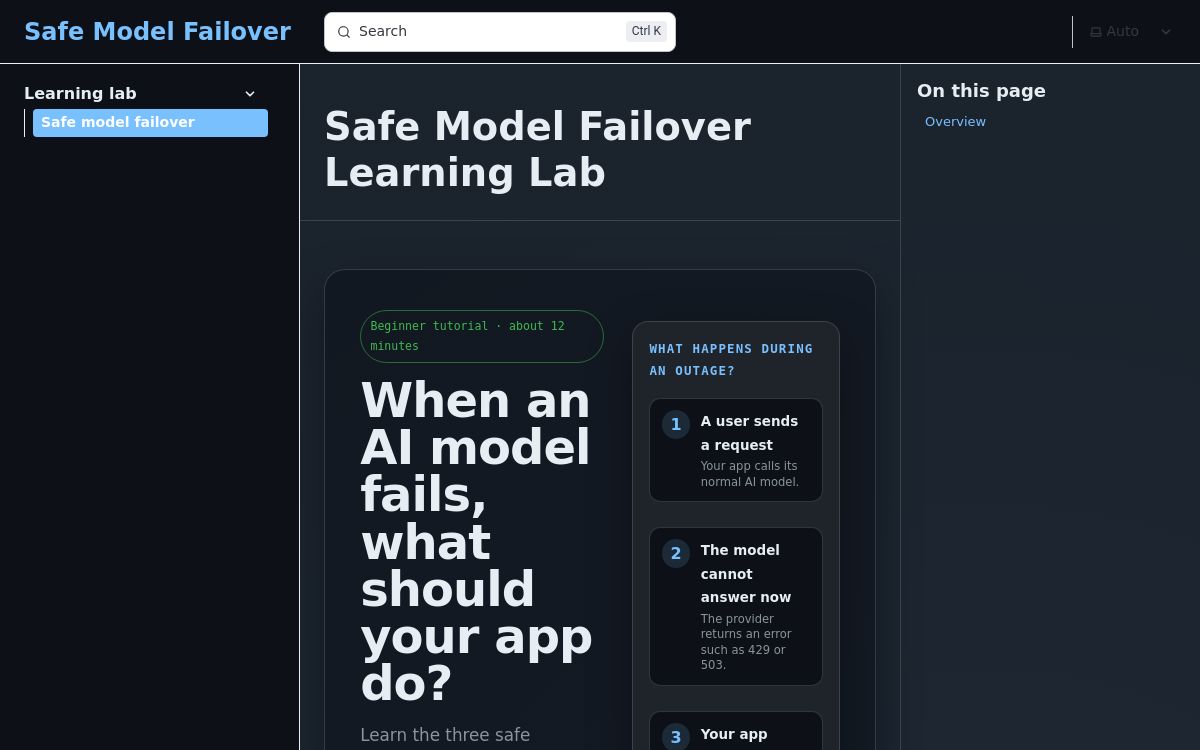
The Safe Model Failover Learning Lab is a browser-local tutorial for choosing exactly one action: wait and retry, use an approved backup, or stop safely. It now teaches the decision in plain language before asking learners to practise it. A simple request, failure, and decision walkthrough leads into a glossary, a guided incident, short exercises, and an optional knowledge check.
The tutorial compares provider-managed capacity and model-routing features across AWS, Google Cloud, Microsoft Azure, OCI, and IBM Cloud. It makes the ownership boundary explicit: managed routing may reduce failures, but the application still owns its retry budget, backup approvals, tool state, and recovery of dependent services.
The deterministic policy honors provider delay signals such as Retry-After. A fallback is allowed only when its model, Region, and tools are allow-listed and its safety controls, output schema, capability, and data boundary remain compatible. State-changing tool work blocks retry and fallback unless idempotency protection is explicit.
What it demonstrates
- A retry must fit the provider delay, attempt limit, and end-to-end latency budget.
- Provider capacity routing can improve availability; it is not a substitute for an application recovery plan.
- A circuit breaker protects dependencies and reopens through a controlled half-open probe.
- Availability never expands the approved safety, schema, residency, or tool boundary.
- Every routing decision should record its classification, budgets, circuit state, approvals, action, and reason.
Verification and research basis
The current version passes 50 deterministic policy and evidence-store tests plus its production build. The lab contains no credentials, analytics, backend calls, remote fonts, or model-provider calls. Learning evidence stays in browser storage and can be exported or reset.
The August 2026 tutorial upgrade reviewed 60 Exa search results across eight provider-focused searches, then validated the final guidance against ten current first-party documentation pages from AWS, Google Cloud, Microsoft Azure, OCI, and IBM Cloud. The linked sources are available inside the lab.
This is a demo learning lab for understanding production model failover patterns. It is not a production router, availability benchmark, or service endorsed by AWS, OpenAI, Microsoft, Google, Oracle, IBM, or any model provider.