
writing
The Hard Part of Agentic AI Starts After the Demo
A working prototype proves possibility. Production requires a separate discipline for autonomy, reliability, security, cost, and operations.
First published on LinkedIn.
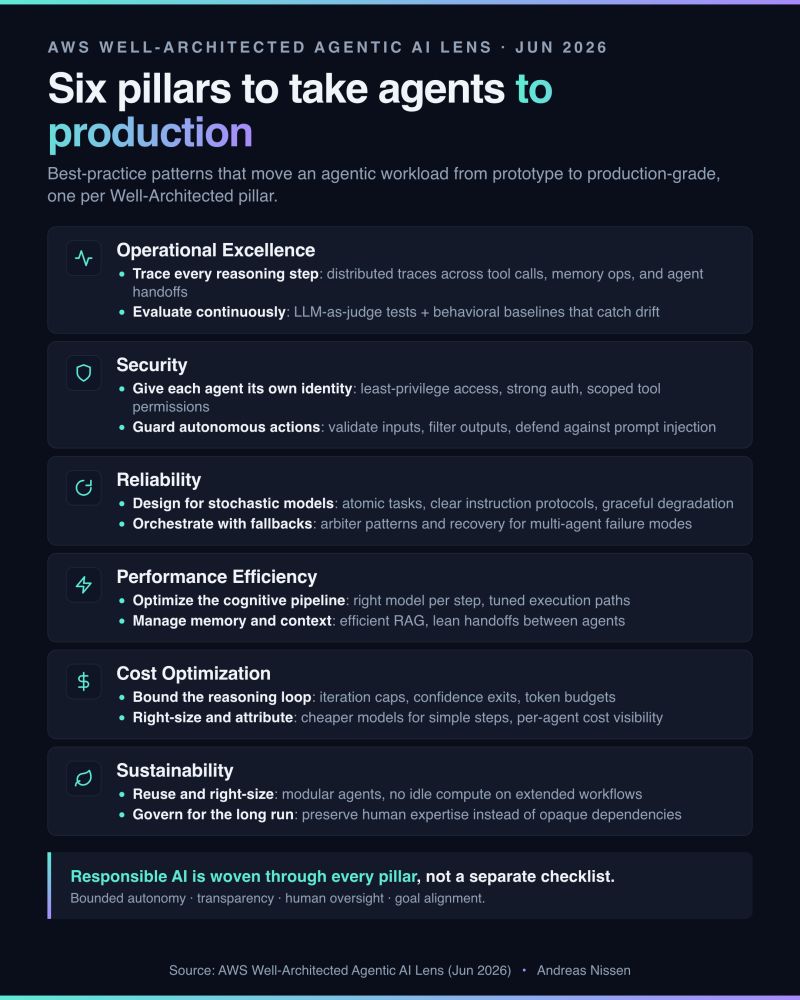
The hard part of agentic AI is not building the agent.
It is everything that happens after the demo works.
A prototype can take a few days. Production is a different discipline. Agents reason in loops, invoke tools, change external state, keep memory, and sometimes produce different answers to the same request. The request-response playbook that teams have used for conventional applications does not cover all of those behaviors.
The AWS Well-Architected Agentic AI Lens gives teams a framework for closing that gap. It adapts all six Well-Architected pillars to the way agentic systems actually behave: operational excellence, security, reliability, performance efficiency, cost optimization, and sustainability.
A demo proves possibility, not readiness
A successful demo usually answers a narrow question: can the model, prompt, tools, and data produce a useful result in a controlled scenario?
Production asks a larger set of questions:
- What happens when a tool is slow, unavailable, or returns stale state?
- Which identity performs an action, and where is authorization enforced?
- How do we test behavior that is useful without being perfectly deterministic?
- How do we trace a multi-step run across model calls, memory, tools, and handoffs?
- When should a human approve, interrupt, or recover the workflow?
- How do we limit reasoning loops and make cost visible per outcome?
- Which artifacts change agent behavior, and how are those changes reviewed and rolled back?
These are architecture and operating-model questions. A better prompt alone will not answer them.
Responsible AI belongs in every pillar
The strongest part of the Agentic AI Lens is that responsible AI is not treated as a separate box to tick at the end. It appears throughout the architecture.
Bounded autonomy is a security and reliability concern. Transparency depends on operational tracing. Human oversight must match the consequence and reversibility of an action. Goal alignment requires evaluation that measures whether the system achieves the intended outcome, not only whether a response sounds plausible.
This makes responsible AI concrete. The discussion moves from broad principles to interfaces, policies, tests, traces, escalation paths, and evidence.
Two practical ways to use the lens
The first is to read it as a design guide. Each pillar helps a team identify the questions it should answer before the system reaches users. This is useful early, when architecture decisions are still inexpensive to change.
The second is to use it as a structured review of an existing workload. Import the lens into the AWS Well-Architected Tool, assess the current design, and turn the findings into an improvement backlog. That gives the team a better result than a general discussion about whether the agent feels production-ready.
A review should still be grounded in the workload. Not every practice has the same priority for every agent. A read-only research assistant and an agent that changes customer data need different controls. The value of the framework is that it makes those decisions explicit.
Start with the failure modes
For teams moving from prototype to production, I would begin with four boundaries:
- Action boundary. Define every operation the agent can perform, the identity it uses, the resources it can reach, and the approval required.
- Behavior boundary. Build evaluations for the scenarios, refusals, handoffs, and failure cases that matter to the business outcome.
- Operational boundary. Trace the complete run and define how the system detects, contains, and recovers from partial failure.
- Economic boundary. Measure model calls, tool calls, retries, and coordination overhead against a useful completed outcome.
Those boundaries expose the difference between a compelling demonstration and a system that can earn trust over time.
The gap between “it works” and “it runs in production” is where many agentic projects stall. The Agentic AI Lens turns that gap into a set of design questions, review evidence, and concrete work.