
writing
Model Failover Is a Policy Decision, Not a Retry Strategy
Retrying or switching models changes capability, cost, latency, and governance. A safe failover path must decide when continuing is still allowed.
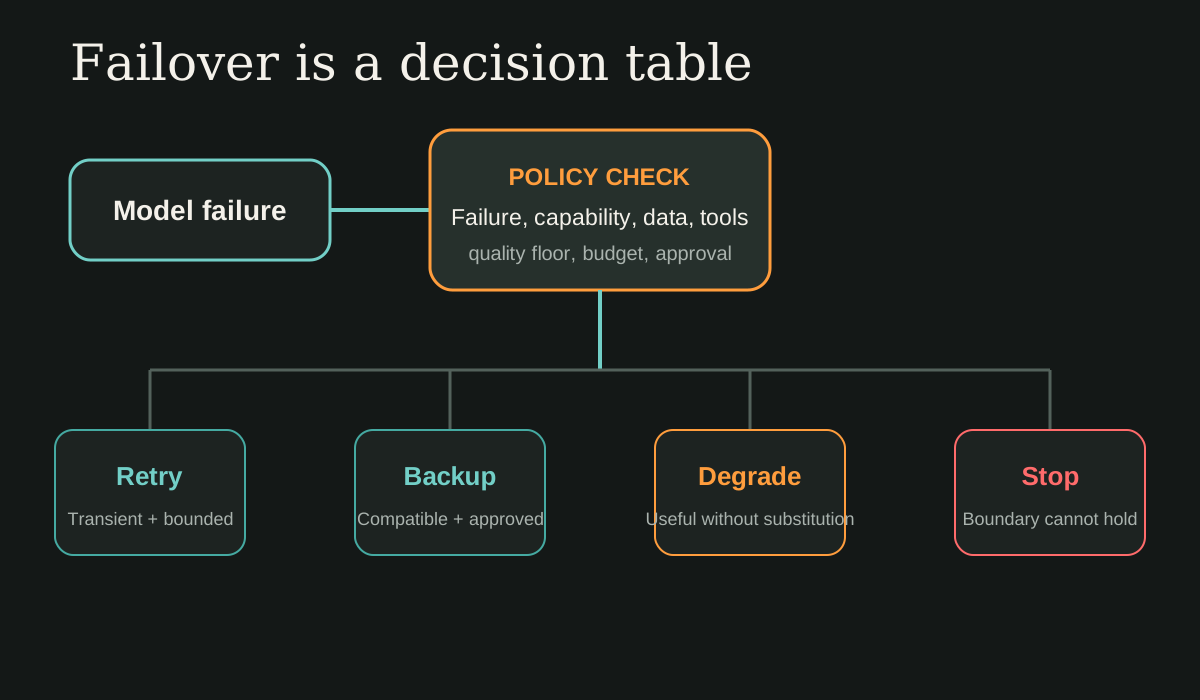
A model failure does not automatically justify another model call.
The next action could be a bounded retry, a switch to an approved backup, a degraded deterministic path, or a safe stop. Choosing among them is a policy decision because every path changes the system’s risk, capability, cost, and evidence.
Treating failover as “catch exception, call model B” hides those changes behind resilience code.
Start with the failure, not the provider
Different failures need different responses.
| Failure | Likely response | Reason |
|---|---|---|
| Transient transport error | Bounded retry | The requested capability and policy boundary remain unchanged |
| Rate limit | Backoff, queue, or approved alternate capacity | Immediate retries can amplify the problem |
| Provider outage | Approved backup or degraded path | Availability changed, and compatibility still needs proof |
| Invalid or unsafe output | Repair once, switch strategy, or stop | Repeating the same request may reproduce the same failure |
| Tool or schema incompatibility | Stop or use a compatible route | A response is not useful if the downstream contract breaks |
| Policy restriction | Stop | Failover must not route around a control decision |
The failure taxonomy matters more than the number of configured providers. It determines whether another attempt has a reasonable chance of producing an allowed result.
Define the failover contract
A safe route evaluates at least six dimensions before switching:
- Capability: Can the backup perform the required reasoning, structured output, modality, and tool use?
- Data boundary: May the same input be sent to that provider, region, account, and retention mode?
- Tool compatibility: Does the backup understand the same schemas and produce results the application can validate?
- Quality floor: Has the backup passed the relevant evaluation cases for this task class?
- Operational budget: Are the additional latency, tokens, and cost still within the request budget?
- User expectation: Does the switch materially change the service or require disclosure or approval?
These checks form a policy contract. The router can automate the decision only after the acceptable routes are defined.
Retry is one route, not the default route
Retries help when the failure is transient and the operation is safe to repeat. They need a total-attempt limit, backoff, jitter, timeout, and a shared budget across the entire request.
The shared budget is important. Three attempts on model A followed by three attempts on model B is not “three retries.” It is six model calls, additional latency, and potentially duplicated tool activity.
For agentic workflows, retry behavior must also respect idempotency. A model request may be safe to repeat while a tool action is not. The orchestrator needs to know which stage failed and whether any external state changed before trying again.
A backup is not equivalent capacity
Two models that both accept text prompts are not necessarily interchangeable. They may differ in tool-call format, context limits, supported regions, safety behavior, output consistency, latency, or evaluation performance.
Provider abstraction is useful when it makes these differences explicit. It becomes dangerous when one generic interface implies equivalence that has not been tested.
The route should therefore name a task class, not only a model. An approved fallback for summarization may not be approved for a policy recommendation, image interpretation, or a consequential tool plan.
Degraded operation can be better than model substitution
Sometimes the safest fallback uses less AI.
A system can return cached evidence, provide a deterministic rule-based answer, save the request for later processing, or let the user continue manually. These paths preserve useful service without pretending the original capability is still available.
Degraded operation should be designed in advance. A vague apology after all model calls fail is not a fallback path. A defined response with scope, freshness, and next steps is.
Know when to stop
Reliable systems need an explicit terminal state.
Stop when the request violates policy, the evidence is insufficient for the required decision, all approved routes exceed their budget, a tool action may already have changed state, or the remaining models have not passed the task-specific quality floor.
Stopping is not the opposite of reliability. It prevents the system from converting an availability problem into a correctness or governance problem.
What the learning lab demonstrates
The Safe Model Failover Learning Lab uses deterministic scenarios to teach four outcomes: retry, switch to an approved backup, use a degraded path, or stop. It applies the same conceptual pattern across cloud providers and keeps the examples provider neutral.
The lab does not call live models or benchmark providers. It demonstrates the decision structure, terminology, and failure paths. Production guidance still depends on the current documentation, contracts, regions, and evaluation results for the services in use.
The practical design rule
Build the failover table before the router.
For every task class, list the expected failures, allowed next routes, retry budget, compatible models, data boundary, evaluation evidence, disclosure requirement, and stop condition. Test the negative paths as deliberately as the successful switch.
The goal is not to always return a model answer. The goal is to keep the system inside its reliability and governance boundary when the preferred model is no longer available.